Skip to content

Benchmarks

Amgix Now Benchmarks Series

  • Keyword Search Benchmarks


    Detailed metrics side-by-side with Typesense, Meilisearch, and Elasticsearch:

  • Hybrid Search Benchmarks


    Detailed metrics of Amgix Now hybrid search performance:

    • Load Tests: CPU Hybrid (Coming Soon) - Hybrid under concurrent loads
    • Load Tests: GPU Hybrid (Coming Soon) - Hybrid under concurrent loads

Is Keyword Search Dragging Your Hybrid Relevance Down?

Hybrid Search Hybrid Search

Whether you are working on a RAG pipeline or a standalone retrieval system, the ability of your hybrid search to surface relevant documents may mean the difference between your agent performing a meaningful next step or sending your system (or user) down a rabbit hole, wasting tokens and time. For the end-user, the difference between a helpful response and a frustrating experience may be one relevant document showing up at the top of the results.

When search behavior is suboptimal, the tendency is to look for, train, or tune a better model. But with hybrid search it takes two to dance. Keyword search and semantic search must work together to surface the best results. Keyword search is often treated as a solved problem, and in many ways it may be. But no two keyword search solutions are the same. Even while implementing similar tokenization, the ranking and fusion math could be drastically different. Leaving your keyword signals unexamined may cause weeks of work focused on the wrong problem.

Amgix Now Load Tests: Mixed Workload

This post is part of Amgix Now Benchmarks Series

Amgix Now - Load Test: Mixed Workload

In the first two Amgix Now benchmark posts we looked at relevance (how well it is able to find what a user is looking for) and search performance under load (how many searches can it handle). This report focuses on Amgix Now performance under mixed concurrent workloads.

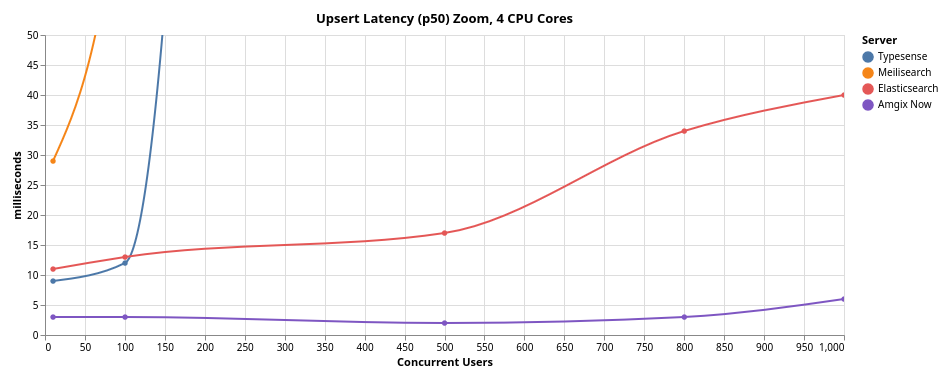
Most real-world applications don't just search. Documents are also being added, updated, and deleted. The mixed workload tests here are designed to simulate that workload: mostly search queries (80%), some upserts (19%), a few deletes (1%). The ability of the search engine to sustain this mixed workload profile under concurrency is an important metric to consider for the search engine viability in production use.

For context, we are also including results from three other popular search engines: Typesense, Meilisearch, and Elasticsearch. We subjected all engines (running with constrained CPU resources) to various levels of concurrent users (from 10 to 1500) to learn how they behave under pressure.

Amgix Now Load Tests: Search Only

This post is part of Amgix Now Benchmarks Series

Amgix Now - Load Test: Search Only

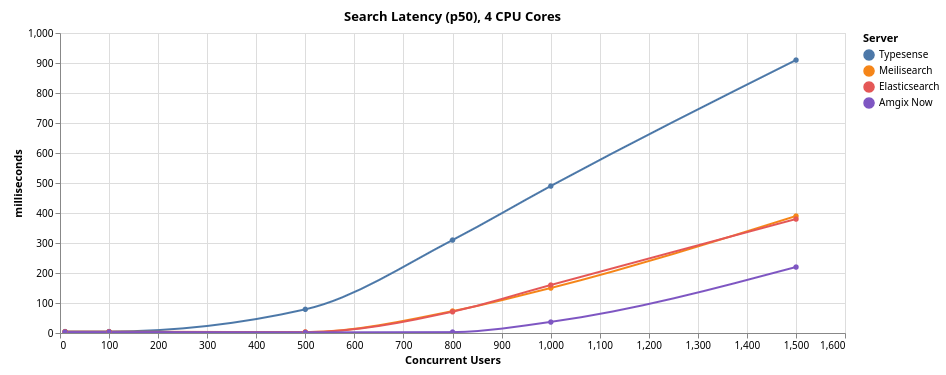
In our previous benchmarks we focused on the relevance and latency metrics of Amgix Now (and three other search engines) across a diverse set of datasets. This report focuses on Amgix Now search performance under concurrent loads. For context, we are also including results from three other popular search engines: Typesense, Meilisearch, and Elasticsearch. We subjected all engines (running with constrained CPU resources) to various levels of concurrent users (from 10 to 1500) to learn how they behave under pressure. Some of the results genuinely surprised us.

Amgix Now Benchmarks: Relevance and Latencies

This post is part of Amgix Now Benchmarks Series

Amgix Now - Benchmarks: Relevance

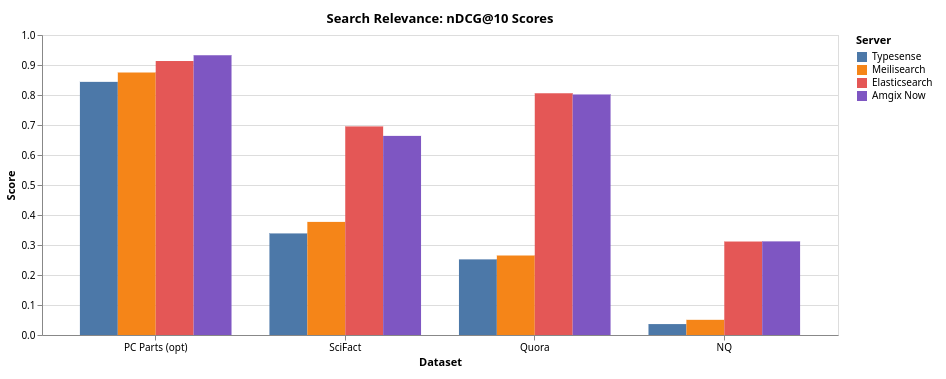
This report focuses on Amgix Now benchmarks, specifically search relevance and latencies across four different datasets. For context, we are including results from three other popular search engines: Typesense, Meilisearch, and Elasticsearch, tested against the same datasets.

Amgix One Under Load: How Much Hybrid Search Can a Single Container Handle?

Amgix One, Keyword, 225 Locust Users

We designed Amgix One to make deployment simple. It's a great choice if you are just starting out with Amgix, or if you have moderate requirements. But what does "moderate" mean in this context? How much work can Amgix One handle? What sort of performance can you expect from this deployment? And what happens if you push it beyond those limits?